Common Tink Frog
Common Tink Frog (Eleutherodactylus diastema) Spanish Name: Martillita

More about Tink Frog
Habitat
The Tink Frog inhabits forests from near sea level up to 1,800 m in elevation, including lowland moist forest and wet forest, premontane wet forest and rainforest, and occasionally lower montane wet forest and rainforest.
Range
Nicaragua, Costa Rica, Panama, and part of western Ecuador are home to the Tink Frog.
Physical Description
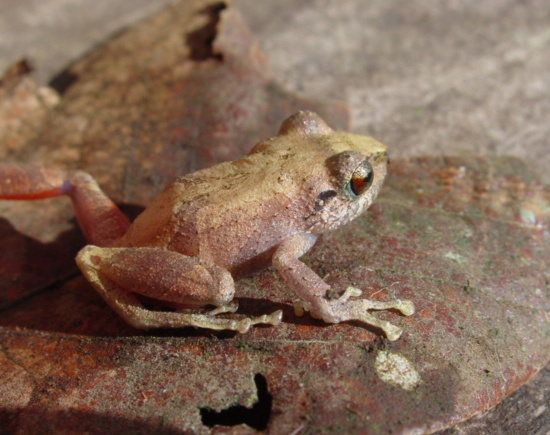
This small frog has large sticky disks on its fingers and toes which help it navigate its tree top existence. The Tink Frog uses short, agile limbs to jump or run short distances or scurry like an amphibian rodent. Its color is variable throughout the day. During the day, when the frog is hiding, it is usually gray to brown with bars or spots in a contrasting color. At night when the frog emerges, it becomes a pink or tan color. The frog’s belly is always pale.
Biology and Natural History
In rainforests throughout Central America, many nights are accompanied by a chorus of frogs calling with a light “tink!” or “dink!” This common nocturnal frog is tiny and hard to see, but it is even harder to miss their call. Some liken the call to the sound of a metal fork on a wine glass. An individual can dink as high as 30-40 times per minute, and with several frogs in an area, the night can turn riotously loud.
In some countries, the species within the genus Eleutherodactylus number more than 500 and are difficult to tell apart; more species are classified in this genus of frogs than any vertebrate genus. Most in the genus call softly, unlike the voluble Tink Frog. This species restricts its activities to tree habitats, from the understory to the canopy. During the day, it hides in bromeliads or tree cavities, or under bark or fallen leaves.
With large silver and brown eyes, this species searches at night for mates. The males leave their daytime coverings for leaves along stream banks, low shrubs, or bromeliads. From their perches they call loudly in duets or even a small chorus led by one male. In the event that a male attracts a female to his territory and they copulate, she may lay up to 10 eggs for him, and he tends to them in a bromeliad where it is moist and safe. Like all Eleutherodactylus species, the Tink Frog skips the tadpole stage. Instead, metamorphosis takes place inside the egg, and miniature froglets emerge from the eggs when they are ready.
Diet
This little frog mostly consumes arthropods, particularly ants.
Height/Weight
Males are 16-21 mm (or 3/4 inches), and females are larger at 18-24 mm (or 1 inch).
Taxonomy
Order: Anura
Family: Leptodactylidae
Source
Leenders, Twan. A Guide to Amphibians and Reptiles of Costa Rica. Zona Tropical, S.A, Miami, FL, 2001.
Savage, Jay M. The Amphibians and Reptiles of Costa Rica: A Herpetofauna between two Continents, between Two Seas. The University of Chicago Press, Chicago, 2002.
-Amy Strieter, Wildlife Writer
